Depression is one of the most common mood disorder, which affects our mental health, and over the years has become a global health concern affecting millions of lives every year. But depression is a term nowadays used arbitrarily. Everyone feels a bit gloomy, sad and lonely at some time or the other. Sadness is a normal reaction to life’s events, loss, break-up, injured self-esteem.
So, how to differentiate clinical depression from a feeling of sadness or loneliness? Depression is a condition when these feelings become unbearable to an extent, which affects us physically, and extends over a long duration, keeping you from having a normal and active life.
What our society does worse is when they see someone suffering from clinical depression they come to offer them advice, tell them to cheer up, life is beautiful, it’s all in your head, look at that person who has worse and is still happy. You should never interfere like that with someone suffering from a clinical depression unless you’re a trained professional.
Immediately take the person to a trained psychiatrist where he can be treated properly. As time is of essence under these circumstances. Now, you might be wondering how can one differentiate whether a person is suffering from clinical depression or is just sad or lonely.
In this blog I’m going to discuss some major and minor symptoms, which if a person is having must be taken to a professional ASAP.
Core symptoms
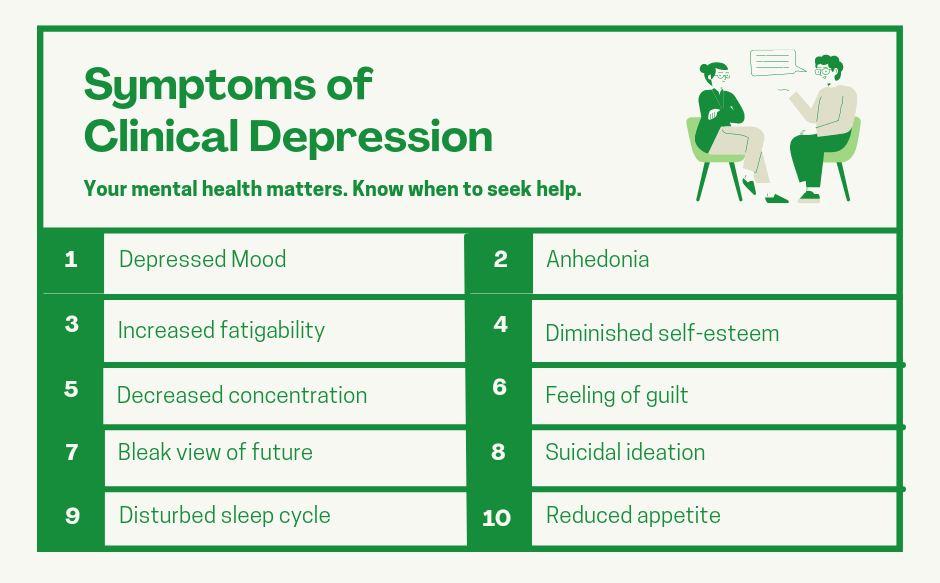
1. Depressed mood
It is a persistent feeling of sadness, irritability. Most of the times there is a trigger for this mood such as unemployment, divorce, break-up, death of a loved one, social isolation, grave illness. But, it may be regardless of a trigger and associated with hormonal imbalance, as in bipolar disorders, post pregnancy depression, schizophrenia.
2. Anhedonia
Individual losses interest and enjoyment in activities previously known to bring them joy. They sometimes can’t even perform self care and hygiene and become socially isolated.
3. Increased fatigability
Individual feels like they don’t have energy to do anything. Sometimes not even enough to get up from their bed and do their daily hygiene activities. This sometimes may be accompanied with headache, chronic body aches, and pain, which may not respond to pain-relieving medications.
Accessory symptoms
4. Diminished confidence and self-esteem
The person suffering from depression has decimated confidence and self-esteem. Which holds them back from performing routine activities and leads to successive failures.
5. Decreased attention and concentration
This symptom is mostly noticed in individuals involved in skilled activities such as students, engineers, teachers etc. as they require attention. While it may go unnoticed otherwise.
6. Feeling of unworthiness and guilt
They feel like they do not deserve anything and blame themselves for everything happening to everyone, not just themselves.
7. Bleak and pessimistic view of future
The pessimistic feeling about their future, they feel like nothing is ever going to change in their lives and this is it. They don’t see any point of doing any activity.
8. Suicidal ideation, attempts and self-harm
Research suggests almost 60% individuals who suffered from depression at least once tried to attempt suicide. And it is never like they do not communicate about their suicidal thoughts to anyone. Almost, always they first let their friends and family know about what they are going to do, but it mostly goes unnoticed. Mostly these communities are perceived as attention seeking behaviour and threats.
9. Disturbed sleep cycle
This is again a very common symptom. Individual either have difficulty falling asleep, or continue to sleep, which is termed as insomnia, or individual is sleeping all the time and have difficulty staying awake, which is termed as hypersomnia (this is less common).
10. Reduced appetite
Individual losses interest in eating, or has a feeling of fullness, or don’t feel like having enough energy to eat.
If an individual has
• 2 core and at least 2 accessory symptoms than they are suffering from mild depression
• 2 core and at least 4 accessory symptoms than they are suffering from moderate depression
• all 3 core and at least 5 accessory symptoms than they are suffering from severe depression
Sometimes even a normal individual may have these symptoms. Then how to differentiate them from someone suffering from clinical depression?
For an individual to be having clinical depression, these symptoms are continuous and lasts for at least 2 weeks. Individuals’ mood is not improved during this period and that’s what hinders all of their routine activities.















 Techazette